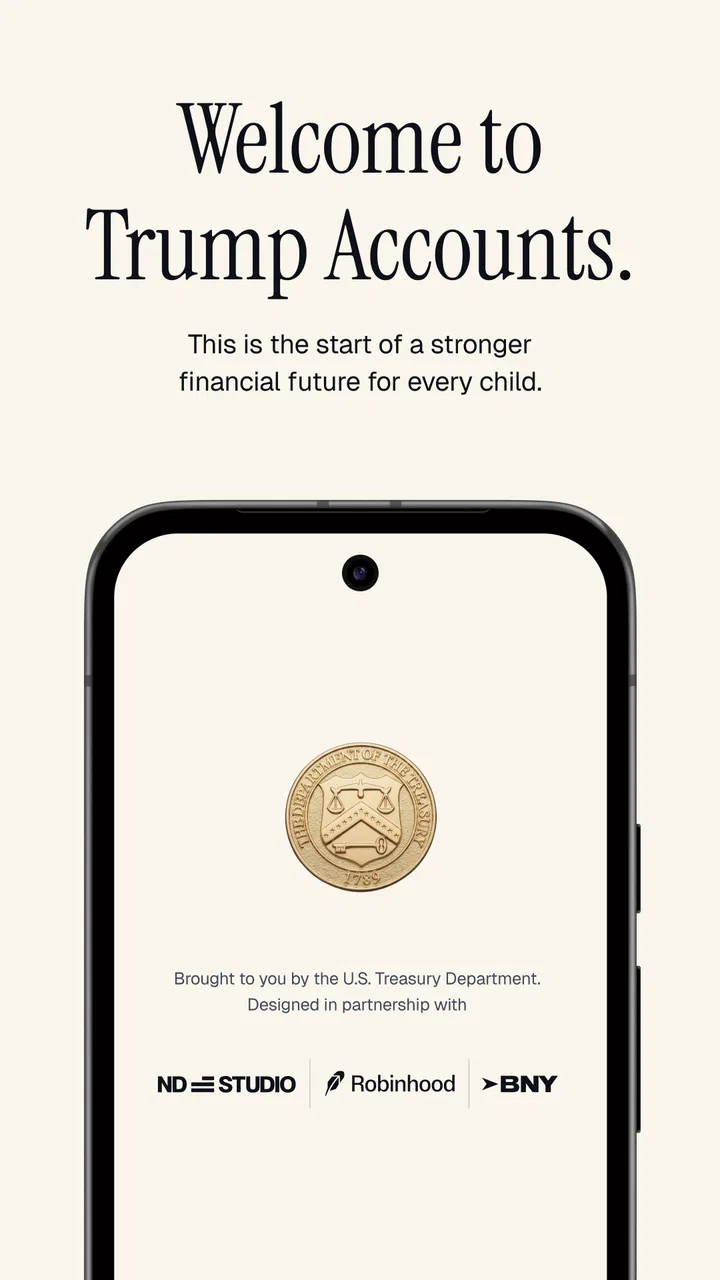
Trump Accounts: Official App
- 4.8
- Rating
- 1.00M
- Installs
- Free
- Price

 Analysis by App-foxy
Saving for a child is one of those jobs that sounds simple until the first form, identity check, or account question appears. Trump Accounts: Official App is aimed at making that process easier to approach from a phone, with a clear focus on investing in a child’s future rather than managing everyday spending. I found it most useful as a central starting point for families who want to understand the account process and keep their next steps organized without relying entirely on scattered web pages or paper notes.
This is a free finance app from the Department of the Treasury, rated for Everyone. Its store summary, “Invest in your child’s future,” gives the right impression of its purpose, although the experience is more administrative than inspirational. It is not a budgeting app, a banking replacement, or a general investment dashboard. That distinction matters before you install it, because the best results come when you treat it as a focused tool for a specific child-related financial task.
Where the experience usually gets stuck
The first surprise is that an official finance app can still feel less immediate than a social or shopping app. You are dealing with personal details, eligibility-related information, and a long-term financial decision. I would not expect to open it casually and finish everything in a few taps. The app’s value is in guiding a serious process, so a little preparation makes the experience much less frustrating.
You May Also Like

 Blood Strike: 2.5 Anniversary
Blood Strike’s Loadouts Turn Every Drop Into a Tactical Gamble
A close look at Blood Strike’s custom loadouts: how fast access to signature weapons reshapes its battle royale rhythm, rewards preparation, and narrows the gap between fights.

 Pandora - Music & Podcasts
Pandora’s Music Is Easy to Start, but Harder to Recover
Pandora’s strength is its low-effort path from a seed to a station. Its weak spot is how much confidence it asks you to place in connection, setup, and quiet recovery.

 8 Ball Pool
 Is Built on Rivalries, Rematches, and Routine
A close look at the rivalries, rematches, shared routines, and unanswered safety questions that turn a quick pool match into a persistent mobile community.

 Samsung Music
’s Quiet Strength Is Playing What You Already Own
Its reach comes less from spectacle than from dependable access to a personal library. That simplicity is both the app’s strongest retention engine and its ceiling.

 AccuWeather: Weather Radar
AccuWeather Review: A Quick, Clear Forecast for Everyday Decisions
For everyday plans, the best forecast is the one you can understand quickly. AccuWeather makes rain timing, radar, and local conditions easy to act on, with a few trade-offs.

 Hill Climb Racing
Why Hill Climb Racing Still Turns Crashes Into One More Run
A tiny car, a bumpy hill and one more upgrade: Hill Climb Racing keeps resurfacing because its simple chaos makes every near-miss feel personal.
More From Our News Desk



Most of the friction is likely to appear when the information entered in the app does not match the records used for verification. A spelling difference, an old address, a missing middle name, or confusion over which adult should complete a step can stop progress even when the phone itself is working normally. When that happens, repeatedly tapping the same button rarely helps. I found it more sensible to pause, review the information carefully, and confirm that the person completing the process is using their own current details.
Another common sticking point is uncertainty about what should happen next. Financial applications often show a confirmation or pending state that can look like an error to someone expecting an immediate result. I recommend reading the wording on each screen slowly and taking a screenshot for your own records when a reference or confirmation message appears. That small habit is particularly useful if you need to leave the app and return later.
The app is also not the right place for rushed decisions. If you are opening it while standing in a school pickup line, without the necessary information nearby, you may create more work for yourself by guessing. A better approach is to set aside a few quiet minutes, keep the relevant documents available, and use a stable connection. The goal is not merely to get through the first screen; it is to submit information accurately enough that you do not have to repair avoidable mistakes afterward.
One practical insight is to separate “understanding the process” from “completing the process.” On the first visit, read the screens and note what the app asks for. On the second, complete the steps with everything ready. This two-pass method is less exciting than trying to finish immediately, but it reduces the chance of entering inconsistent details or abandoning the process halfway through.
Why the official source changes the comparison
Compared with a general personal-finance app, this one has a narrower job. Budgeting tools are better for tracking groceries, bills, subscriptions, and household cash flow. Brokerage apps are usually better for people who want to research investments or manage a broader portfolio. A bank’s app may be more convenient for ordinary transfers and account balances. Trump Accounts: Official App makes more sense when your question is specifically connected to the child-focused account process associated with the Department of the Treasury.
That official connection is its main reason to choose it over a third-party explainer. You are not depending solely on a creator’s interpretation or an unrelated financial service to explain a government-linked process. At the same time, an official app may feel more formal and less polished than a commercial finance product. I would choose clarity and source confidence over entertainment here, but users who want charts, spending categories, or broad investment tools should look elsewhere.
Setup checks that save time
Before opening the app, I would check three things: the phone’s operating-system compatibility, the accuracy of the personal information you plan to enter, and whether you are ready to complete the process for the correct child. The minimum operating-system requirement is Android 7.0, which covers many older devices, but compatibility alone does not guarantee a smooth session. An outdated phone, limited storage, or an unstable connection can still make a form appear unresponsive.
Install it only from the official app listing and check that the developer shown is the Department of the Treasury. That is a simple but important safety habit for any finance application. Avoid copying personal information into an unofficial imitation, and do not treat search advertisements or random download pages as proof of authenticity. For a tool involving a child and financial records, taking an extra moment to verify the publisher is worthwhile.
I would also prepare a quiet workspace rather than trying to complete setup while multitasking. Keep names, addresses, and dates exactly as they should be entered, including punctuation and spacing where relevant. Do not rely on memory if the information is available in an official document. The most useful preparation is not technical; it is making sure the details are consistent before the app asks you to confirm them.
If more than one adult is involved, agree beforehand on who will perform each step. Confusion can arise when one person starts the process, another supplies information, and a third person expects to finish it. Even when everyone is acting in good faith, switching between people can lead to mismatched answers or uncertainty about the current status. I recommend having one responsible adult manage the session and share the confirmation details with the family afterward.
Do not assume that installing the app means a financial account is already active. Installation gives you access to the app; it does not replace the steps shown inside it. Read each confirmation carefully, and keep any completion message or reference information somewhere secure. This is especially helpful if you later need to distinguish between an application that was started, one that is awaiting action, and one that was completed.
The app is free to download, which removes one barrier for families exploring the process. Free, however, does not mean that every financial consequence or eligibility question disappears. The app should be used as a practical channel for the account process, not as a substitute for reading official terms or seeking qualified advice when your family’s situation is complicated.
A safer first-session routine
My preferred routine is straightforward. First, verify the publisher and the version shown in the app listing. The current version is 2026.22.2, so keeping the installation current is sensible when you are dealing with a formal process. Next, close other demanding apps, connect to a reliable network, and make sure the phone has enough battery. Finally, complete one screen at a time and stop if the wording becomes unclear instead of guessing.
That routine also helps answer a question many people have: can someone use the app without being comfortable with investing? Yes, the app can still be useful as a process guide and account-related starting point, but it should not be mistaken for a full investing education platform. If you need help understanding risk, taxes, ownership, or long-term planning, use the app alongside trustworthy official guidance or a qualified professional rather than expecting the interface to answer every personal question.
Families should also think about privacy before handing the phone to a child. Because the purpose involves a child’s future, the adult managing the process should keep control of the device and any confirmation information. A child may be the reason for the account, but that does not mean the child should be asked to handle sensitive details or make decisions they do not understand.
Recovering when a workflow stops
When a screen fails to advance, I would start with the least disruptive checks. Confirm that the connection is still active, close and reopen the app, and make sure the current version is installed. Then return to the last clearly completed step rather than repeatedly submitting the same information. Repeated attempts can make it harder to remember what was accepted and what still needs attention.
If the app closes unexpectedly, write down the last screen you remember and any confirmation message you saw before reopening it. This creates a simple timeline. It also prevents a common mistake: restarting the entire process immediately and accidentally creating duplicate attempts. If the app shows a status that suggests the request is still being processed, give that status priority and look for the next instruction instead of beginning again.
A useful recovery method is to change only one variable at a time. If you move from mobile data to Wi-Fi, do not simultaneously edit every field and reinstall the app. If the problem disappears, you will not know what fixed it. Test the connection first, then restart the app, then review the entered information. This is basic troubleshooting, but it is particularly valuable in finance because preserving a clear record matters more than experimenting quickly.
There is also a difference between a rejected entry and a technical failure. An error message about information usually calls for careful review of the field, while a blank screen or sudden closure points more toward the app, device, or connection. Treating both situations as “the app is broken” can waste time. I would copy the exact wording into a private note, without sharing sensitive personal information, so that any later support conversation is precise.
One non-obvious advantage of keeping a small paper or private digital checklist is that it helps families coordinate without passing sensitive information through casual messages. Record the date of your attempt, the child concerned, the last completed stage, and any non-sensitive reference shown by the app. Do not write passwords or expose personal identifiers in an unsecured note. The checklist is for workflow memory, not for storing credentials.
When starting over is the wrong move
Starting over feels tempting because it gives the impression of control, but it is not always the best response. If you reached a confirmation screen, save that information first. If the app indicates that a step is pending, wait for the next instruction rather than creating another submission. If you are unsure whether anything was accepted, review the app’s current status after reopening it. Only restart when the interface clearly shows that the previous attempt was abandoned or when official guidance tells you to do so.
This is where the app’s focused design can be both helpful and limiting. A narrow government process may not offer the same reassuring progress visuals or troubleshooting explanations found in consumer apps. I prefer not to interpret a quiet screen as proof that nothing happened. Instead, I would preserve the evidence available, avoid duplicate actions, and use the appropriate official support route if the status remains unclear.
Users often ask whether deleting and reinstalling will solve everything. It can clear a local glitch, but it should not be your first response when a process may already have recorded information. Before reinstalling, note the last known status and any confirmation details. Reinstallation is a technical reset, not a correction for inaccurate personal information or an unresolved eligibility question.
When the app is not the cause
Not every difficulty originates in the application. A mismatch in government records, an incomplete document, a household change, or uncertainty about who is authorized to act can produce the same feeling as a software error. If the app is displaying a clear instruction about information or eligibility, follow that instruction rather than trying unrelated phone fixes. Restarting a handset cannot correct a record that needs to be reviewed.
The same applies to delays. A financial or government-linked workflow may involve steps outside the phone, so an immediate result should not be assumed simply because the interface is responsive. I would distinguish between the app accepting your input and the broader process reaching its final stage. Keep the confirmation details, monitor the status shown, and avoid making financial plans based solely on an expectation that a submission has already completed.
Another important boundary is advice. The app may help you access or manage the specific process, but it is not automatically a replacement for tax guidance, estate planning, or personalized investment advice. If your child has a complex family situation, if several adults have competing responsibilities, or if you are unsure how a future account fits into your wider finances, a qualified adviser may be more useful than any app. The official tool can remain part of the workflow without being the only source of judgment.
Who should skip it? I would skip it if you are looking for a complete household money manager, a spending tracker, a stock research platform, or a place to compare many investment products. It is also a poor fit if you want an app that explains every financial concept in beginner-friendly depth. In those cases, a budgeting app, a brokerage platform, or a reputable educational resource will serve you better, while this app remains relevant only for the specific child-account task.
Who is it best for? I see the strongest fit for a parent or guardian who wants an official mobile starting point, prefers handling paperwork digitally, and is willing to check details carefully. It can also suit a family that needs a shared process rather than a collection of informal instructions. The app’s Everyone rating makes it broadly accessible from an age-classification standpoint, but the financial responsibility still belongs with the adult managing the information and decisions.
My practical verdict after using it
I would recommend Trump Accounts: Official App to someone who specifically needs the Department of the Treasury’s child-focused account process and wants a direct mobile route. Its average rating is 4.6 from around 49 ratings, and the app has passed the ten-thousand-install mark, which suggests that it has attracted a real audience while remaining a relatively focused tool rather than a mainstream finance suite. Those figures are useful context, but my recommendation is based more on fit than popularity.
The strongest part of the experience is its purpose. It does not try to become your bank, your budget planner, and your investment research terminal at the same time. That focus can make it easier to know why you are opening it. The Department of the Treasury as developer also gives the app a clear official identity, which is important when the task involves a child’s financial future and sensitive personal information.
The main weakness is that focused official tools can demand patience. You may need to prepare details, interpret formal wording, and recover carefully when a step does not behave as expected. I would not call that a reason to avoid the app, but I would call it a reason to use it deliberately. The best experience comes from accurate preparation, one responsible adult handling the session, and a written record of meaningful confirmations.
In an everyday scenario, imagine a parent who hears about the account while planning school expenses. Instead of trying to complete the process during a busy morning, that parent installs the free app, verifies the publisher, waits until the evening, gathers the child’s information, and works through the screens without guessing. If a status remains unclear, the parent saves the confirmation, avoids duplicate submissions, and checks the next official instruction. That workflow is less stressful and safer than treating the app like a quick sign-up form.
My final view is positive but deliberately narrow: this is a useful official finance app for the right job, not a universal solution for family money management. Use it when your goal is connected to Trump Accounts, prepare before starting, and separate technical troubleshooting from questions about records or eligibility. If you want broad financial tools, choose a different category of app. If you want a focused mobile doorway into this specific process, it is a sensible app to keep available.
FAQs for Trump Accounts: Official App
01What features does the Trump Accounts: Official App offer?
The Trump Accounts: Official App provides users with exclusive content, including news updates, videos, and live streams. It also offers a social media platform where supporters can connect, share opinions, and engage with official announcements. The app includes a customizable user interface, allowing easy access to personalized content based on user preferences.
02Is the Trump Accounts: Official App free to download and use?
Yes, the Trump Accounts: Official App is free to download on both Android and iOS devices. However, while the app itself is free, there may be in-app purchases or premium features that require payment. Users can choose to access additional content or experiences through these optional purchases.
03How does the app ensure user privacy and data security?
The Trump Accounts: Official App is designed with user privacy and security in mind. It implements robust data encryption and adheres to strict privacy policies to protect user information. Additionally, users can manage their privacy settings within the app to control what data is shared and with whom.
04Can I use the app to engage directly with official Trump announcements?
Yes, the app is specifically designed to facilitate direct engagement with official Trump announcements. Users can access live streams, read news updates, and participate in discussions within the app. This interactive element allows users to stay informed and express their views on various topics.
05What are the system requirements to run the Trump Accounts: Official App?
The app requires Android 5.0 or later, or iOS 11.0 or later for installation. It is optimized for both smartphones and tablets, ensuring a seamless experience across devices. Users are recommended to have a stable internet connection for the best performance, especially when accessing live content or streaming videos.
Pros
- User-friendly interface with easy navigation.
- Real-time updates and notifications.
- Exclusive content not found elsewhere.
- Integration with social media platforms.
- Customizable notification settings.
Cons
- Limited to Trump-related content only.
- Subscription required for premium features.
- No offline access to content.
- Occasional app crashes reported.
- Limited interaction with other users.

Trump Accounts: Official App
Gallery